
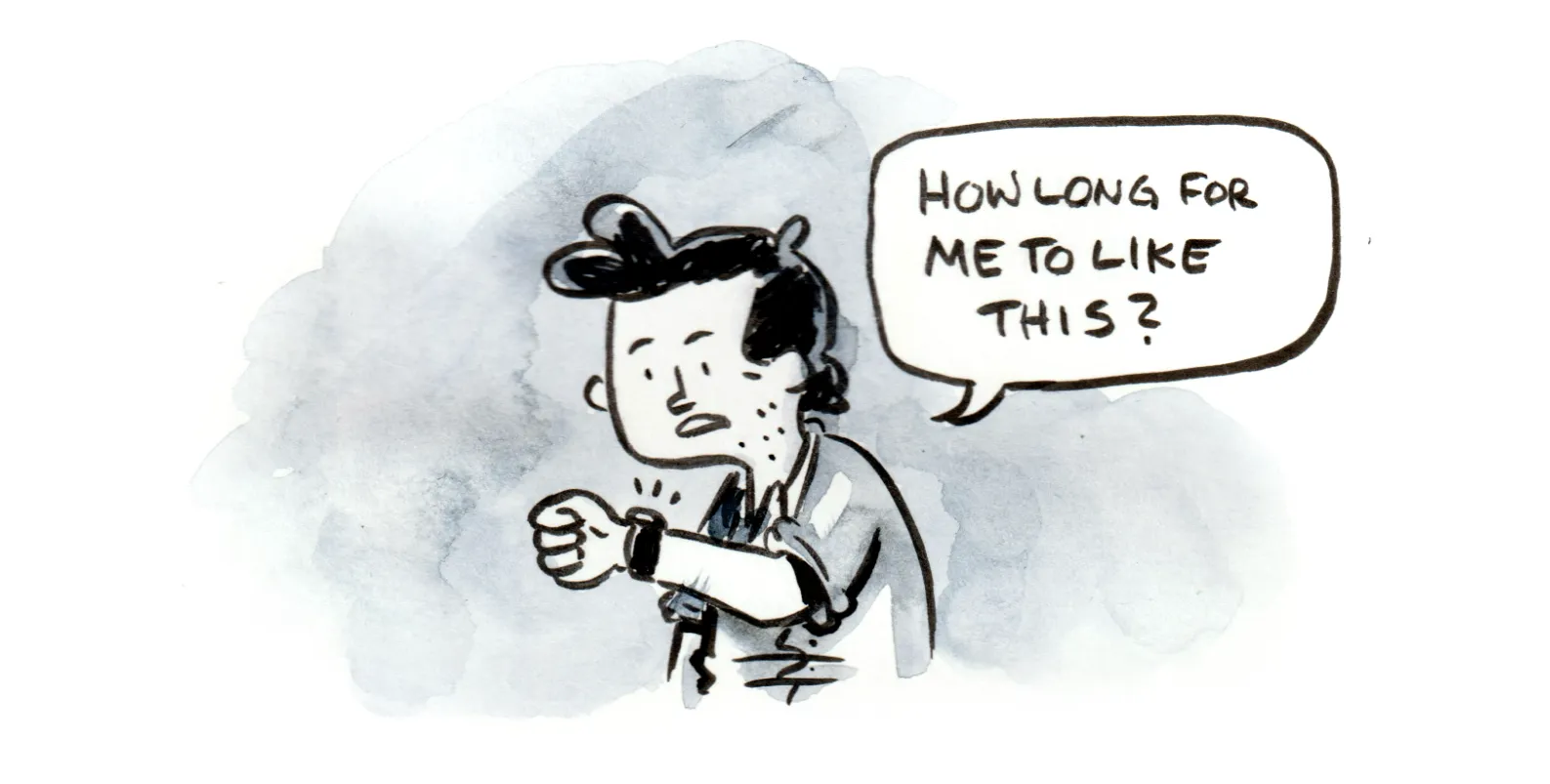
Something I notice regularly, and only recently managed to wrap my head around, is this phenomenon:
Step 1: I draw something and hate it.
Step 2: I step away and let a bit of time pass.
Step 3: I come back to it and suddenly it isn’t as bad as I thought it was.
Why does that happen?
Here’s my theory: When drawing, I have the intention of doing something a certain way. I want a shape to look just right, a line to curve in just the right direction. That intention is so strong in the moment that every deviation from it feels like failure. All my mind notices is how what I’ve done differs from what I wanted to do.
When I step away from it, perhaps sleep on it and have another look in the morning, that story often changes quite a lot. The intention is gone, or at least much weaker, and I’m able to see the result for what it is. I look at it without the same expectations and see not what isn’t there, but what is.
Men are disturbed not by things, but by the views which they take of things.
— Epictetus, Enchiridion, 5
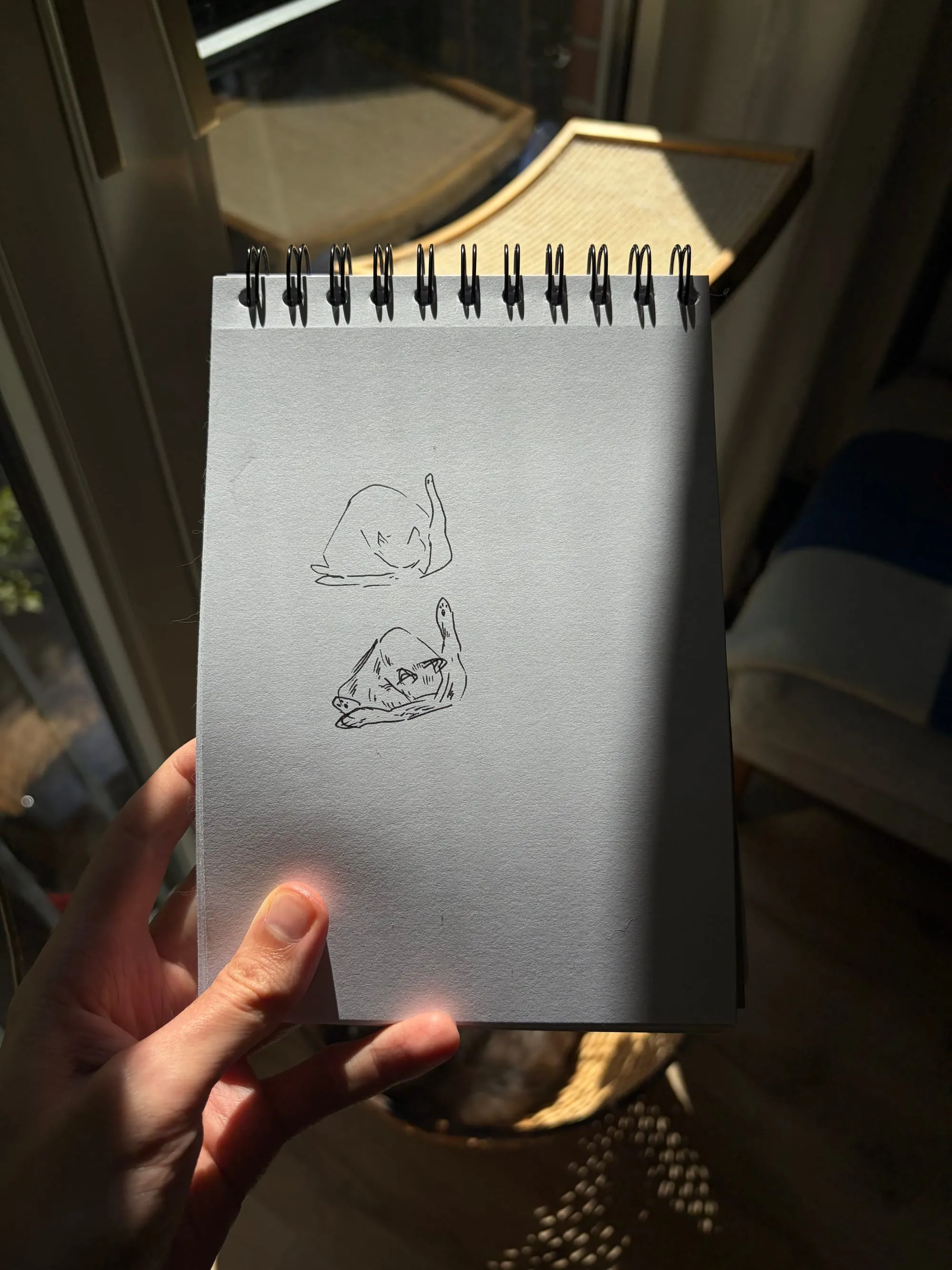
Take the picture above as an example. I aborted that first drawing of Millimeter licking her bum hole because it didn’t look at all like I wanted it to. Something about how thin her antenna-leg came out bothered me. I immediately liked the second one better.
Then this block lay around for a couple of days, and today I looked at it again and kind of liked the first version as well.
The second one is obviously better in the sense that it’s a bit more realistic. But the thing itself, its “Gestalt,” in that first iteration isn’t inherently bad. It’s more stylized, more abstract, less anatomically correct, but it still clearly reads as a sketch of a cat following an intense hygiene regimen for her butt.
I’m thinking about this because I’m trying to get better at abstraction. The art that moves me the most isn’t art that perfectly depicts a landscape or cityscape like a photograph. It’s often heavily stylized and only resembles reality in theory.
But every time I try to do something like that myself, I get lost in details, proportions and perspective, even when getting those things “right” would probably only make the artwork worse. There’s this strange contradiction where I’m drawn to abstraction in other people’s work, but while making my own, I keep judging it by how accurately it matches the thing in my head.
And that’s why I keep coming back to those “yolo, I’ll just do something random and see how it goes” experiments. After leaving them alone for a day or two, I almost always like them better than the experiments where I know I did a better job mechanically.
There’s probably a life lesson hiding in here somewhere. So much disappointment seems to come not from what something is, but from the distance between what it is and what someone had decided it was supposed to be. Turns out, the Stoics were right. It’s all about perspective. In art as in life, there’s rarely just one right way of seeing things.
After the paywall for premium members: a couple of my landscape sketches that I still don’t really like, but that feel like they’re slowly getting somewhere. The less they look like reality, the more I like them. You’d think that would make things easier, but somehow it doesn’t.
