
My friend Mareen gave me Austin Kleon’s Show Your Work for my birthday, and I recently read it. I’ve never actually read anything by Kleon, even though my friend Eva has mentioned him dozens of times over the years.
It’s was exactly the right read for me at this time. I’ve been sharing more work than ever this year, but it’s still so tied up with self-doubt, the pressure to be successful (whatever that even means, because I’m not sure myself), and the ever-present question: who cares about this?!
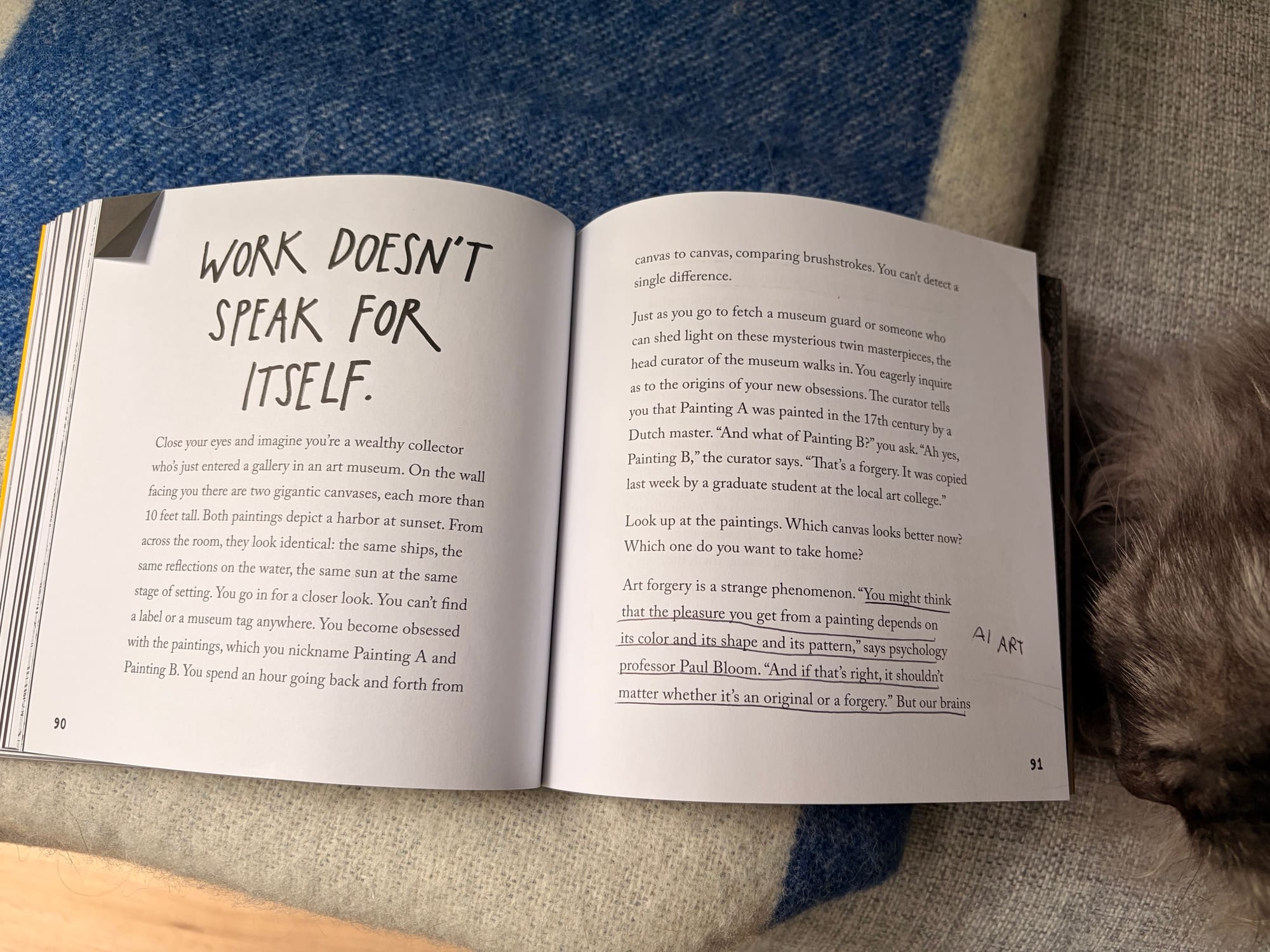
This paragraph caught my attention:
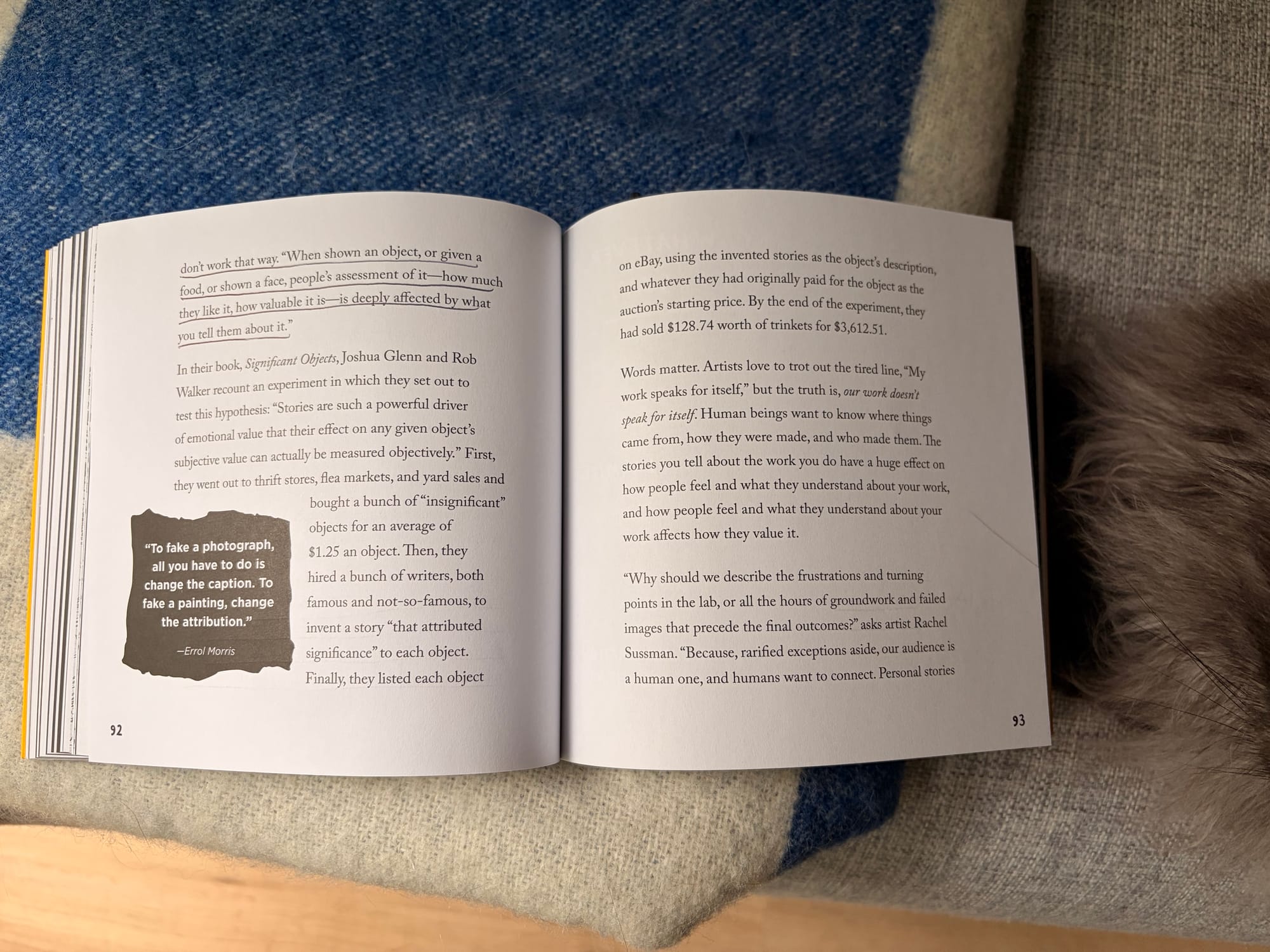
"You might think that the pleasure you get from a painting depends on its color and its shape and its pattern," says psychology professor Paul Bloom. "And if that's right, it shouldn't matter whether it's an original or a forgery." But our brains don't work that way. "When shown an object, or given a food or shown a face, people's assessment of it-how much they like it, how valuable it is-is deeply affected by what you tell them about it."
The beginning of this chapter explores an original work of art and a perfect forgery, and why the original automatically feels more valuable to us: it carries a story and a creative journey with it that goes far beyond someone simply copying it. We feel connected to the past of the object, not just its simple existence.
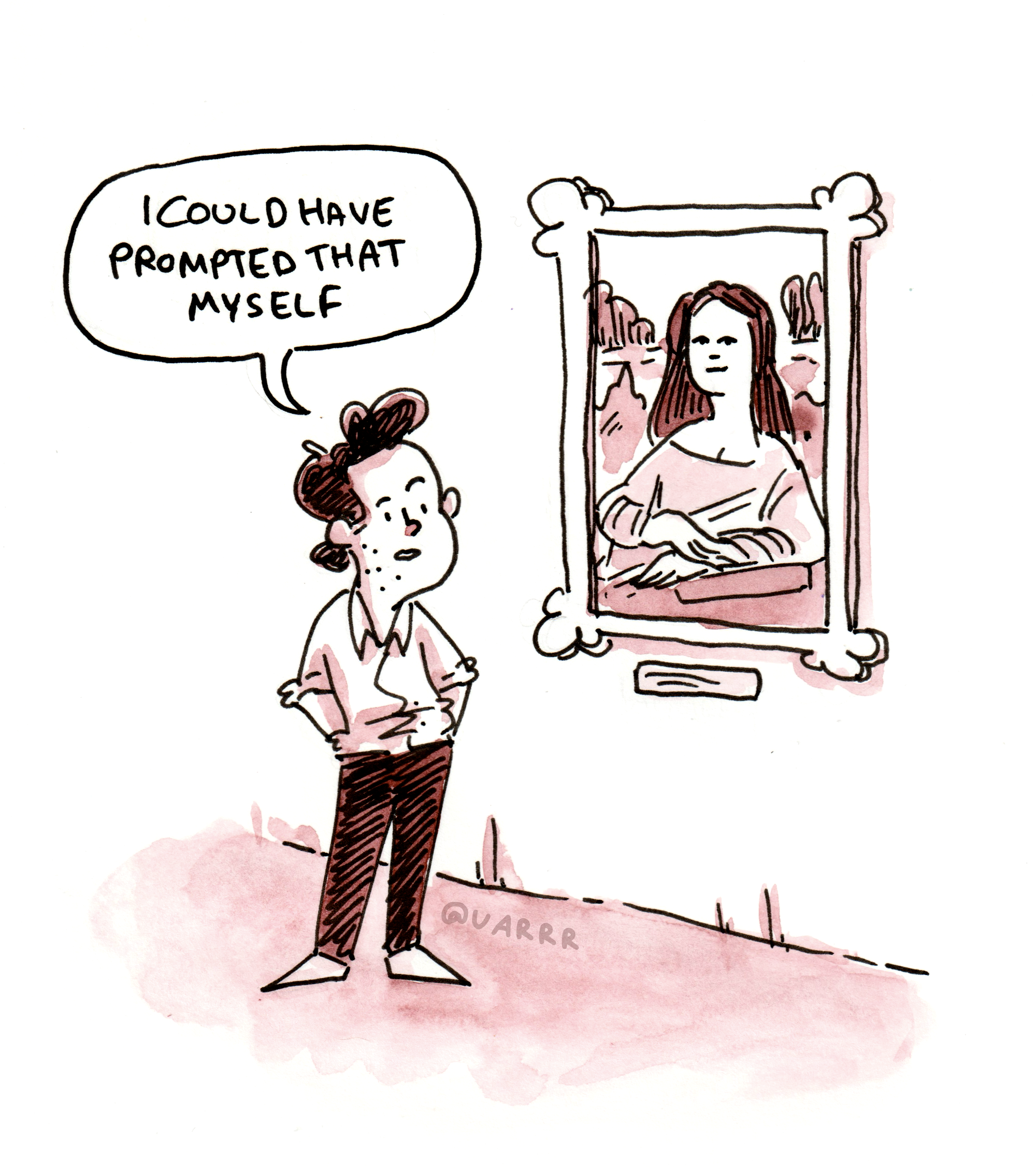
The fact that our enjoyment of art seems to be measurably higher when the art has a (human) story behind it should make all the people clamoring on about how AI is going to kill all creative pursuits let out an immense sigh of relief.
This paragraph resonated with me a lot because I never understood the fear that generative AI might ring in the end of art. Of course it doesn't. Will it be able to forge more or less anything perfectly at some point? I believe so. Will it be able to fabricate a relatable human backstory, a creative journey, a Leidensweg (path of suffering)? Absolutely. But it can't make that story true. It can't have actually lived through any of it.
My creative journey has only just properly started, and I could ask myself whether it's even worth making art anymore. Why should I invest hours of work in something that can be prompted a lot quicker? I could watch so much Netflix instead!
But I feel in my bones that it's worth it. It's worth it because the process of sitting down, thinking about what I want to draw or paint, experimenting to get it right, and being happy or unhappy with the result is far more worthwhile than just the end result. The obstacle is the way.
AI might eventually be able to give me almost any end result I can imagine. But it can't give me the experience of having made it.
I recently listened to a podcast episode about a woman remembering her favorite book series from when she was a teenager. She decided to find out more about the author and, heavy spoilers, it turns out she doesn't exist.
It was never one person writing those books, but a large team of writers. They just slapped some name on the cover and called it a day.
Over the course of the podcast, the host talks to the publishing company that handled things like this for years, and here's the kicker: They discovered that readers don't like it. Readers want to have a connection to the person behind the words. Which is why they eventually started having a head writer for each project and putting that person's name on the books.
People care about people.
Will there be some non-existent AI band that'll release the hit of the summer 2028 that millions of people will dance to? Sure. AI might become incredibly good at satisfying our appetite for content. Songs to listen to, images to look at, stories to pass the time with. Entertainment fodder. And there's always been consumption without much care about the artists in the background.
But satisfying our appetite for content isn't the same thing as replacing everything we value about art.
There's also always been enjoyment of art because of the artist in the background. Because of who made it, why they made it, what they went through while making it, and how it fits into everything they made before and after. And I'd argue that this is the kind of connection AI can't replace—the sense of human provenance behind the work.
If anything, in a world where technically impressive images, songs, and stories can be generated endlessly, knowing that an actual person sat down and made something might become more valuable, not less.
AI can automate the production of cultural objects. It can't automate having been a person who made one.
Let's not focus on the fodder.
And for Premium members of this publication, here's a collection of random sketches I made in the last couple of days. With my bare human hands! I am human and I made something, witness me!
